Design Dissertation –
Polyvalent Adaptability
Year 05 | Semester 09 | 2021
Work in progress
What is the realm between functionalist specificity and generic flexibility?
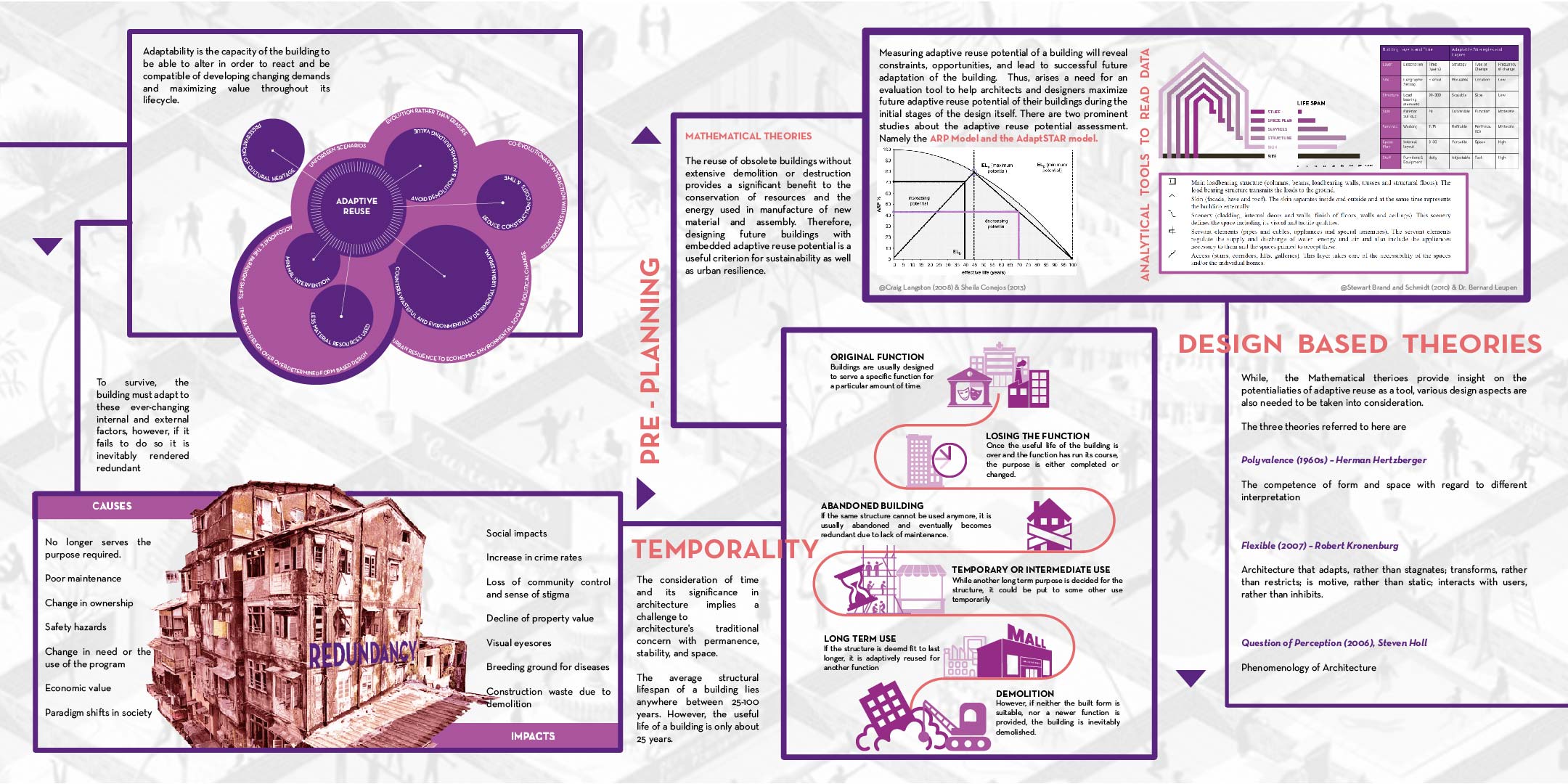
Adaptability is the ability of a building to be altered in order to react to and be compatible with developing, changing demands and maximise value throughout its lifecycle. Redundant spaces in the building can be rendered habitable with minimal interventions, thereby avoiding prolonged and expensive demolition. Apart from the obvious preservation of a place’s cultural heritage and historical value, adaptive reuse also offers a counter to wasteful and environmentally detrimental urban sprawl. Buildings can be designed to respond to changing conditions because of their dynamic qualities. This is possible through their interrelationship with the constantly evolving external and internal causes.
The pandemic experience of 2020 has reinforced the importance of flexible design, which can accommodate paradigm shifts and a wide variety of unforeseen scenarios. Adaptability and urban resilience towards economic, environmental, social, and political changes are critical for the relevance of a particular entity. Adaptive resilience establishes a co-evolutionary interaction between stakeholders and the system, i.e., the structure itself. The importance of time-based design thinking as opposed to overdetermined form-based design thinking has slowly but surely become evident. By adding a new layer without erasing earlier layers, an adaptive reuse project becomes part of the site’s long history. It is another stage, not the final outcome, and it contributes to evolution rather than erasure (Sennett).
Our cities’ contemporary structures would be considered the heritage of tomorrow. This should be taken into consideration during the designing phase of a building and should include adaptive reuse as a potential strategy to meet the requirements of the future. As a result, adaptability becomes critical in embodying spatial, structural, and service strategies within the building. Therefore, allowing the tangible a level of malleability to respond to users’ needs over time will extend the building’s lifespan.